Google Global App Summit: App Monetization takeaways
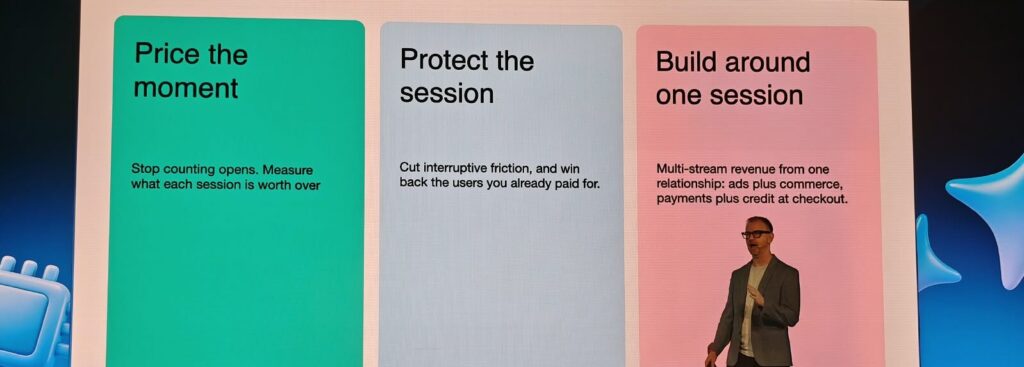
Google’s Global App Summit 2026 focused on one idea: the app market is mature, so growth now comes from the value of each session, not from new installs. Below a few key takeaways for app publishers and ad monetization teams, with data from Sensor Tower’s State of Mobile 2026.
1. The app market grows in depth, not in width
More competitors now fight for the same pie. However, the pie is not getting bigger. Smartphone sales are declining, so fewer new users enter the market each year.
Sensor Tower’s data confirms this trend. In 2025, global downloads grew by just 0.8%. In contrast, in-app purchase revenue grew by 10.6%. Mobile games show an even clearer gap: revenue rose 1% while downloads fell 7%. As a result, publishers must grow from their existing user base.
2. Value per session matters more than installs
At the same time, AI makes it faster and cheaper to build apps. Consequently, the number of published apps keeps rising. User attention, however, stays the same.
On average, a user opens around 10 apps per day and about 34 per month. Every publisher competes to be on that short list. For this reason, an install or a first open is no longer the goal. Instead, the key question is how much each session is worth over time.
For ad monetization teams, this means tracking retention, sessions per user and ARPDAU, not only installs and impressions.
3. Some markets are still growing, and India runs on ads
While mature markets flatten, a few countries keep growing. Speakers highlighted Pakistan, Nigeria, India and the Philippines.
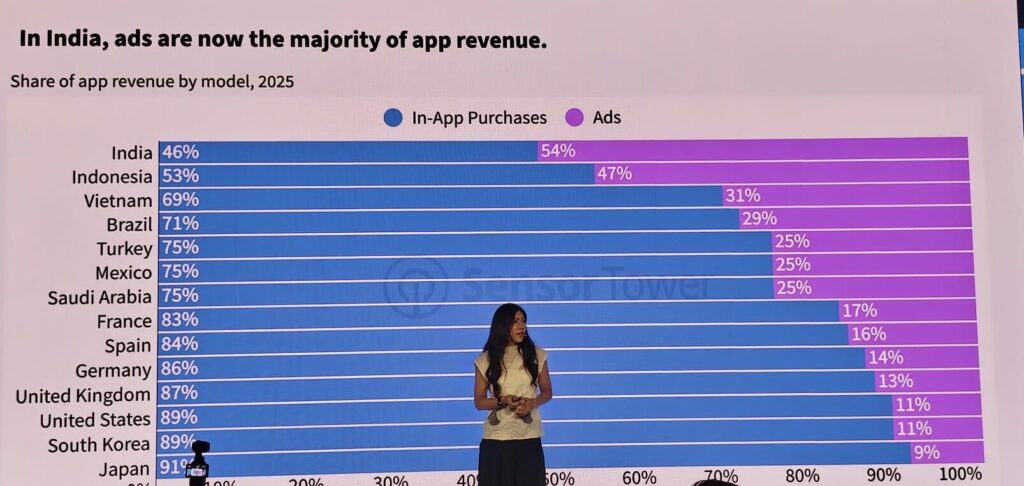
India stands out in particular. According to Sensor Tower, ads now generate 54% of app revenue there, compared with 46% from in-app purchases. By comparison, ads represent 11% in the United States and 9% in Japan.
So if your app relies only on IAP or subscriptions, these markets give you a strong reason to add an ad monetization layer.
4. AI and automation: promising, but worth testing
As expected, AI and automation dominated Google’s agenda. Many of the new features look promising. Still, we need to test them in practice to see where they add real value.
The AdMob MCP for instance lets you query your AdMob account in natural language to get an immediate overview of issues and opportunities.
5. Ad quality is a revenue lever
Google also presented several tools to support ad quality. In one session Božo Janković showed how bid floors on interstitials can improve user experience without hurting revenue. The logic is simple: fewer low-value interstitials improve the overall UX, adding bid floors at specific price points will push ad ARPDAU even if impressions will decrease.
6. High-attention ad formats keep gaining share
Demand is also moving towards high-attention formats. According to Sensor Tower, among ads promoting mobile games, rewarded grew from 11.5% to 17.7% of impressions in 2025. Over the same period, playables more than doubled, from 6.3% to 13.3%.
Among the new formats presented at the summit, picture-in-picture deserves attention. However, two questions remain open: how many publishers will adopt it, and how much inventory will be available. For this reason, I would test it before drawing conclusions.
7. Leadership lessons from Carles Puyol
Finally, one session went beyond apps: Barça legend Carles Puyol spoke about leadership and humility, team dynamics and how commitment is (usually) more important than pure talent.

Conclusion
To sum up, the app market is mature, the number of apps keeps growing and attention is limited. The publishers who grow will be the ones who increase the value of each session and protect it.



0 Comments